
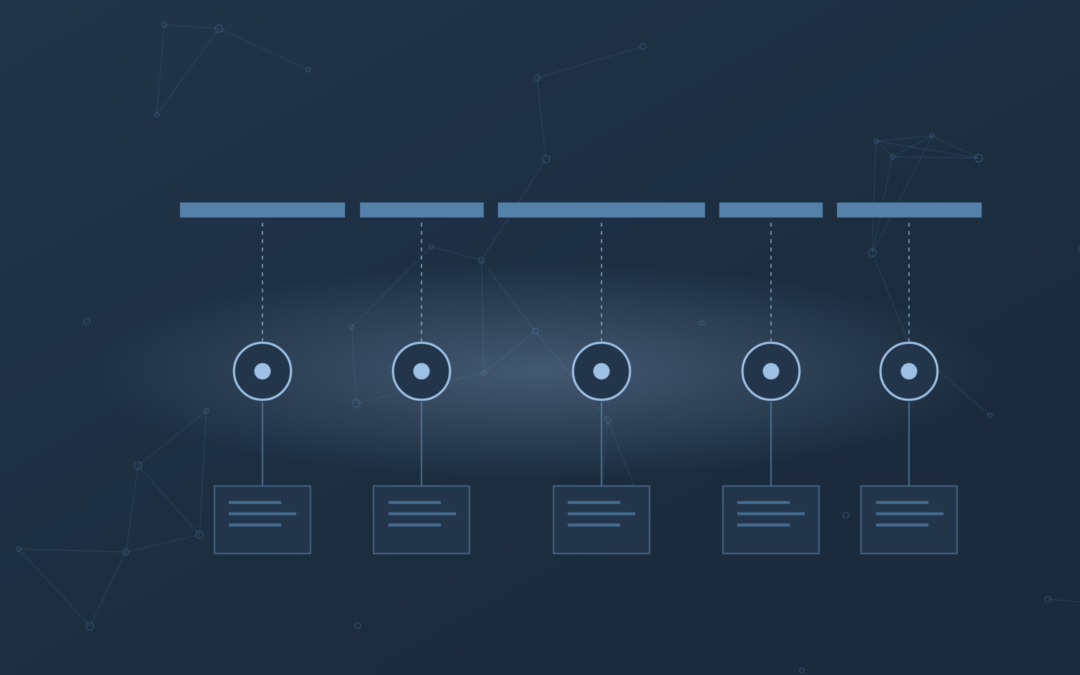
Atoms, the Prompt Cage, independent verification and continuous monitoring: four building blocks for governing AI from the outside
Generative AI writes fluently. It does not know what an organisation is entitled to say. Better models make errors rarer, but they cannot make them impossible: a probabilistic system cannot be made certain from the inside.
Validix takes a different route. Instead of trying to make the model trustworthy, it governs what the model is allowed to assert, from outside the model, claim by claim and continuously. This is what Validix calls Governed Claims Infrastructure. It rests on a patent-pending Atomic Claim Architecture, made of four building blocks: Atoms, the Prompt Cage, independent verification and continuous monitoring.
Atoms: knowledge broken down to its smallest validated units
Most organisations keep what they know in documents: studies, specifications, policies, reports. A document is a poor unit of governance. It mixes dozens of statements, each with its own source, its own scope and its own lifespan, and it is approved as a whole.
Validix starts by breaking evidence down into Atoms: the smallest units of validated knowledge. Each Atom carries a single piece of meaning, is traceable to its source and to the context in which it is valid, and is structured for reuse. Approved Atoms can be reused to build governed claims. Each carries its source and conditions of use. From then on, a claim is no longer a sentence buried in a document. It is a governed object, made of identifiable parts, each with a known origin.
The Prompt Cage: AI builds only from what has been approved
The second building block constrains generation itself. For each request, the Prompt Cage sets the boundaries of what may be generated. Inside it. For each request, the Prompt Cage supplies approved Atoms and applicable drafting constraints. A separate check assesses the actual output against those permissions. It can only build a claim from a valid, evidence-backed combination of Atoms. A statement that no validated Atom supports has nothing to be built from.
Validix applies claim-level controls during drafting and again before release. The Prompt Cage works the other way round: generation is constrained by approved claims from the start, and content can only be built from approved, substantiated claims. The model still does what it does well, such as phrasing, adapting tone and fitting a format. The substance comes from the Atoms, not from the model.
Independent verification: a second check before release
Constraint at construction is not treated as enough on its own. Before any claim or piece of content is released, it is broken back down into its individual assertions, and each one is checked again against the Atoms meant to support it, independently of how it was produced. This is not a rewriting step. It is a second, separate checkpoint.
Where an assertion cannot be traced to a supporting Atom. Where a required qualifier or accompanying statement is missing, or support cannot be verified, Validix can withhold the output or route it for review. It fails closed. In a governed environment, no answer is a better outcome than an unsupported one.
Continuous monitoring: governance that does not stop at approval
Evidence moves. Studies are updated, specifications revised, policies rewritten, rules amended. A claim that was correct when it was approved can become wrong without a single word of it changing. Periodic review cannot see this happen; it only finds out at the next audit, if at all.
Validix keeps the link between claims and their evidence alive. Evidence is monitored, Atoms are updated, and impacted claims are flagged as the evidence and the rules evolve. Because every claim knows the Atoms it is built from, and tracked materials retain links to the claims they use. Changes to monitored evidence or rules can trigger reassessment. A change at the source reaches the claims and content that depend on it, rather than forcing a review of everything. Governance becomes continuous rather than periodic.
Why the combination matters
Each building block answers a different question. Atoms: what do we know, and where does it come from? The Prompt Cage: what is AI allowed to build? Independent verification: did anything unsupported get through? Continuous monitoring: is it still true? Each one is useful on its own. Together, they form an infrastructure.
Two properties hold the whole together. First, the model generates, but the decision about what may be the release gate applies defined rules to reconstructed assertions and the governed state. Second, the governance sits outside the model, so it does not depend on any AI provider and organisations can change supported generation models while retaining the same governance rules. Control is built into how claims are produced, rather than checked at the end: Compliance by Design.
Why we built Validix
At Validix, we believe the question is no longer whether organisations will let AI speak on their behalf, but on what terms. We did not set out to build a better writing tool. We set out to build the layer that decides what AI is allowed to say, and that keeps every claim connected to the evidence behind it, for as long as that claim is in use.
We are a team of scientists and entrepreneurs based in Switzerland, and our Atomic Claim Architecture is patent pending. Our first application, built for life sciences, is ready to be demonstrated. We are now opening a limited number of pilot partnerships with organisations that want to put AI to work on claims they must stand behind. If that is you, we would like to talk.
AI generates. Validix governs.